
Food Rights Alliance, in partnership with UNICEF, Action Against Hunger, World Vision, and the Ministry of Health, convened the 2nd Nutrition Financing Dialogue at the Sheraton Hotel in Kampala under the theme “Financing for Nutrition: A Pathway to Achieving Government Commitments to End Malnutrition.” The dialogue brought together stakeholders from government, academia, civil society, the private sector, and the media to reflect on Uganda’s nutrition financing landscape.
The meeting aimed to assess the current state of nutrition financing in Uganda, identify key gaps and challenges, explore policy and institutional opportunities, and generate actionable recommendations to inform national planning and budget processes. It also sought to strengthen multi-sectoral coordination and explore innovative and sustainable financing mechanisms for nutrition.
Panel Discussion: Civil Society Perspectives
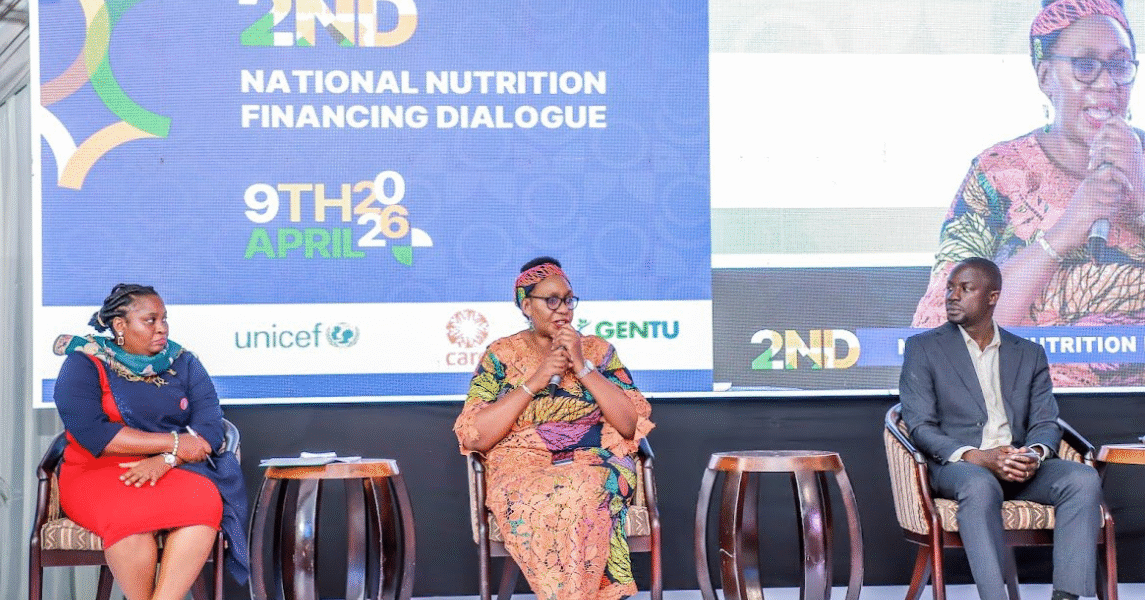
A key highlight of the dialogue was the panel discussion on the state of nutrition financing in Uganda, where the Executive Director of Food Rights Alliance, Agnes Kirabo, discussed the trends on nutrition financing from a civil society perspective.
She noted that Uganda has made visible progress in aligning financing with national planning frameworks, particularly in the transition from NDP III to NDP IV. This alignment, she emphasized, has improved coherence in reporting and reflects deliberate government efforts to harmonize actions among state and non-state actors.
However, she cautioned that persistent challenges in nutrition outcomes are not solely due to limited resources. “Money has never been in abundance. We are always complaining that resources are scarce. However, the trends suggest that we are not actually short of resources; rather, we are short of deliberate action, prioritization, coherence, and alignment,” she stated.
Her remarks pointed to a systemic issue in Uganda’s nutrition financing architecture, fragmentation, and weak coordination across sectors. She stressed the need for stakeholders to align efforts, avoid duplication, and strengthen collaboration to maximize the impact of available resources.

Ms. Agnes Kirabo speaking on a panel during the 2nd Nutrition Dialogue
Scaling Tested Solutions
Kirabo also highlighted that several game-changing actions and solutions have already been implemented and tested. Under the CASCADE project, Food Rights Alliance, in partnership with the National Planning Authority of Uganda, has developed the Nutrition Planning Priorities Guide for Ministries, Departments, and Local Governments, and with the Ministry of Local Government Uganda, developed a Handbook for the Promotion of Nutrition Interventions through the Parish Development Model in Uganda.
Using these tools, and in guidance with the respective Ministry or Department, FRA facilitated the orientations of the stakeholders in the Toro, Acholi, and Karamoja sub-regions. There is now a need to scale up these efforts and provide continuous support to implementers to ensure effective utilization of the tools across Uganda.
As Uganda continues to implement the National Development priorities, the outcomes of the 2nd Nutrition Financing Dialogue are expected to inform policy direction, budget allocation, and program implementation. Stakeholders called for a renewed focus on alignment, prioritization, and coherence to translate commitments into measurable nutrition outcomes.
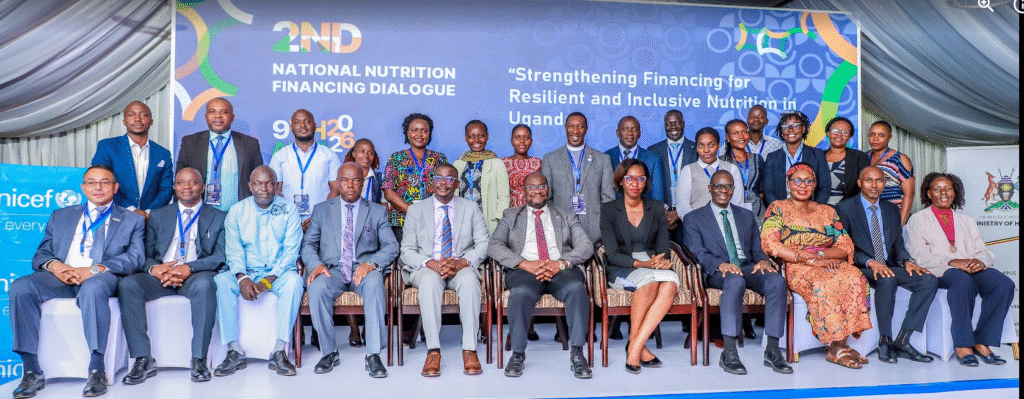
Group photos capturing participants at the 2nd Nutrition Financing Dialogue