
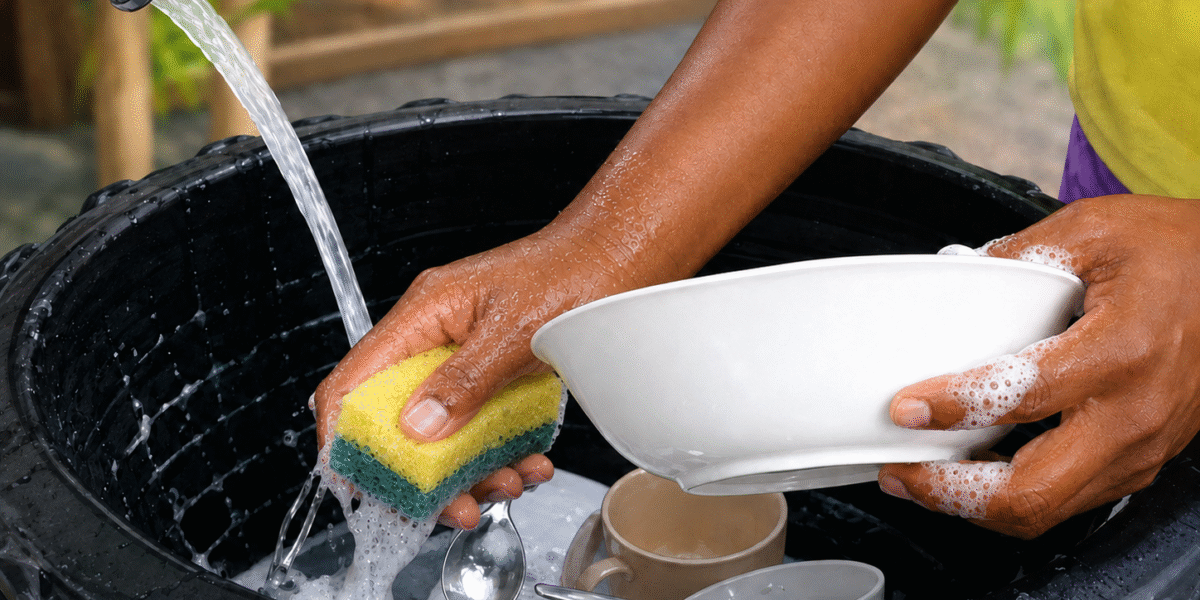
That damp, unassuming sponge sitting by your sink might be the most dangerous item in your kitchen.
Picture this: you have just enjoyed a delicious meal. You wash the utensils with your trusted sponge, rinse, and stack them on the drying rack. Job done, right? Wrong. That sponge, warm, moist, and teeming with food particles, has just become a five-star hotel for billions of bacteria.
The Ugandan Reality
A study in Uganda found that 68% of food vendors only replace their sponges when visibly damaged long after they’ve become dangerous. Even more alarming, 69% store their sponges in containers without proper drying, creating ideal conditions for microbial growth. And 62% change their wash water only 1–3 times daily, allowing contaminants to accumulate.
The numbers are staggering. Research on kitchen sponges found aerobic mesophilic bacteria counts ranging from 7.43 to 12.44 log CFU/mm³. To put that in perspective: that’s billions of bacteria per cubic millimeter of sponge.
What’s Growing in Your Sponge?
Pathogens persist inside sponges for at least two weeks, even when they appear dry. E. coli and Salmonella rapidly establish stable populations reaching approximately 9 log CFU per sponge section. These bacteria survive prolonged desiccation and transfer up to 5 log CFU to surfaces under mild pressure, exactly what happens when you wipe a plate.
A study of 100 household sponges found 22.3% carried Extended Spectrum Beta Lactamase (ESBL)-producing bacteria superbugs resistant to multiple antibiotics. Pathogens identified included Cronobacter sakazakii (14.6%), Enterobacter cloacae (28%), and Citrobacter freundii (23.3%).
Why Sponges Are Worse Than Other Utensils
Sponges present the highest microbial load compared to all other cleaning utensils. Unlike brushes that dry quickly, sponges retain moisture, creating a perfect breeding ground. Visual assessment is a poor indicator of microbial contamination that sponge may look clean but harbor armies of pathogens.
The Drying Rack and Towel Trap
Even if your sponge is clean, consider your drying practices. Towels used to dry utensils are frequently reused for multiple purposes, contributing to cross-contamination. Outdoor drying racks expose clean utensils to dust, flies, and airborne contaminants..
Your Action Plan
· Replace sponges every 1–2 weeks, never wait until they look or smell bad
· Dry sponges thoroughly between uses—never store in closed containers
· Use dish brushes instead, they are more hygienic and safer
· Change the wash water frequently after every few items
· Air-dry utensils and towels can reintroduce bacteria
The human right to adequate food includes the right to food that is safe. This World Food Safety Month of June, let us remember: safety starts not at the farm, but at the sink.