
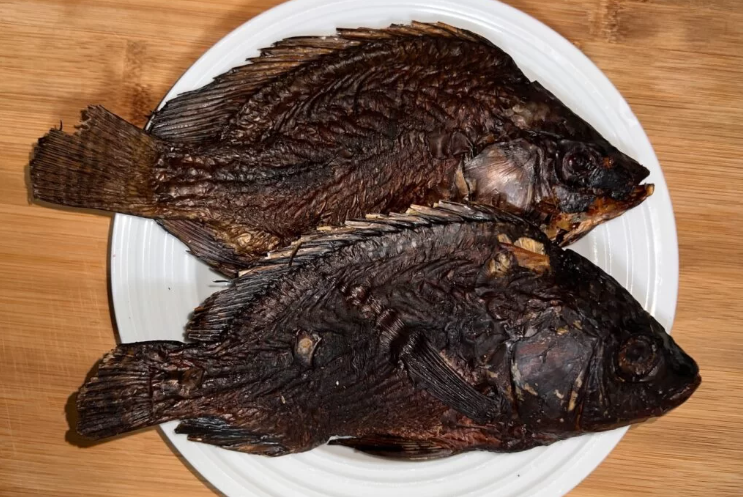
There is a scent that defines the evening meal in many Ugandan homes: the rich, woody aroma of smoked fish cooking in groundnut paste, blending with the earthy steam of freshly pressed matooke.
For the Baganda, a dish of empuuta (smoked Nile perch) or mukene (silver cyprinid), painstakingly stripped and mashed into a savoury relish for plantains, is more than sustenance; it is heritage. Across the Busoga, Ateso, and Acholi regions, smoked fish bridges the gap between harvest and hunger, providing a portable, long-lasting protein source that has sustained communities for generations.
Fish is also an important source of affordable protein and essential nutrients. The Food and Agriculture Organization explains that fish supplies high-quality protein, healthy fats, and micronutrients such as iron, zinc, calcium, iodine, and vitamins A, D, and B12. Small fish eaten whole, including species such as mukene, can be especially valuable because the head, bones, and internal organs contain concentrated nutrients.
However, preserving fish with smoke must be done safely. When traditional smoking methods are poorly controlled, the same smoke that extends the life of the fish can also introduce harmful chemical contaminants.
The Deep-Seated Risks in Traditional Smoking
Walk into any landing site along Lake Victoria or Lake Kyoga, and you will witness the hazard firsthand. Fish are artfully arranged on wooden racks over open flames, often inside rusty oil drums or under stifling polythene tents. Although these methods are affordable and familiar, uncontrolled exposure to smoke can produce polycyclic aromatic hydrocarbons (PAHs) when wood, charcoal, and other organic materials burn incompletely. Some PAHs are associated with cancer, and benzo[a]pyrene is commonly used as an indicator of contamination in smoked foods. A Ugandan study of smoked Nile perch sold in three markets in Gulu detected nine PAHs, with total concentrations ranging from undetectable levels to 53.23 micrograms per kilogram. The risk increases when fish is placed too close to the fire, unsuitable fuels are used, smoking continues for too long, or dripping fat falls onto hot embers, creating additional smoke that carries PAHs back onto the fish. FAO and WHO guidance therefore recommends placing a metal sheet or another barrier between the fish and the heat source.
Chemical and microbial contamination create further risks. In some African fish-processing markets, agricultural and household pesticides have reportedly been misused to protect drying or smoked fish from flies and beetles, with studies outside Uganda detecting residues of dichlorvos, DDT, and lindane. Dichlorvos, sometimes sold under the brand name “Sniper,” is an organophosphate insecticide that affects the nervous system and can cause excessive salivation, diarrhoea, tremors, breathing difficulties and convulsions. However, no reliable Ugandan study was found to support the claim that pesticide residues occur in more than 40% of smoked fish sold in central Uganda, highlighting the need for systematic testing. Poor hygiene during gutting, drying, storage and transportation also exposes fish to disease-causing microorganisms. A 2024 study involving 466 Nile perch handlers in Uganda found that only 31.8% knew about pathogens such as E. coli, Salmonella and Staphylococcus, while 81.3% of market-stall handlers had poor knowledge of food-safety requirements. This is the often invisible cost of poorly processed smoked fish: contamination may not change its familiar colour, aroma or taste, but it can still expose consumers and processors to preventable health risks.
Scientific Alternatives: NARO’s Quiet Revolution
There is hope, and it comes from our own soil. Scientists under Uganda’s National Agricultural Research Organisation have developed the NARO PAH-Safe Fish Smoking Kiln, also known as NAROFIK. Unlike traditional open-fire systems, the kiln controls the movement of heat and smoke, separates fish from direct flames, and filters impurities before the smoke reaches the product. The technology was designed to reduce PAH contamination to about two parts per billion while also protecting processors from prolonged smoke exposure. Depending on the model, the kiln can process roughly 400 to 700 kilograms of fresh fish a day, making it suitable for both small-scale and commercial use.
The kiln also reduces the labour and health burdens associated with traditional smoking. Women using the technology have reported cutting processing time from two or three days to about 12 hours, while producing fish that lasts longer and attracts better prices. For small fish such as mukene, raised drying racks and enclosed solar dryers offer another safer option by protecting fish from dust, animals, insects, and direct contact with the ground while speeding up drying. These technologies can reduce reliance on heavy smoking and lower the risk of insect infestation, but they cannot eliminate pesticide misuse on their own. Strong enforcement, processor training, access to safer preservation equipment, and routine residue testing are still essential.
To protect the right to adequate food without erasing our cultural identity, we must urgently pursue the following actions:
- Outlaw and enforce penalties for pesticide use in processing: The Uganda National Bureau of Standards (UNBS) must institute mandatory random testing at major collection centres, with heavy fines or closure for offenders caught using Dichlorvos or similar chemicals.
- Scale up NARO’s improved kiln technology via subsidised loans: The Microfinance Support Centre should partner with district local governments to provide low-interest credit facilities specifically for fishers and processors to purchase or construct these safer kilns.
- Introduce a “Smoke Safety” grading seal: Create a market-driven tier system, e.g., “Grade A” for kiln-smoked fish with a food safety certificate, and “Grade B” for open-smoked fish requiring mandatory boiling before consumption. This empowers consumers to choose safety.
- Launch culturally tailored public health campaigns: Educate households on simple risk-reduction practices, such as carefully peeling off the charred outer skin of smoked fish before cooking, which removes the bulk of surface PAHs and pesticide residues.
Tradition Must Meet Integrity
Fish is the people’s protein. It is the backbone of our nutrition and the heartbeat of our lakeside economies. But a delicacy drenched in carcinogens and neurotoxins is a betrayal of the families who gather around that evening plate of matooke. We owe it to the Baganda grandmothers and the Busoga fishermen to ensure that “pasted” means preserved, not poisoned. Science has handed us the solution; now, governance must deliver the mandate. Let us keep the smoke, but ditch the hazards.