
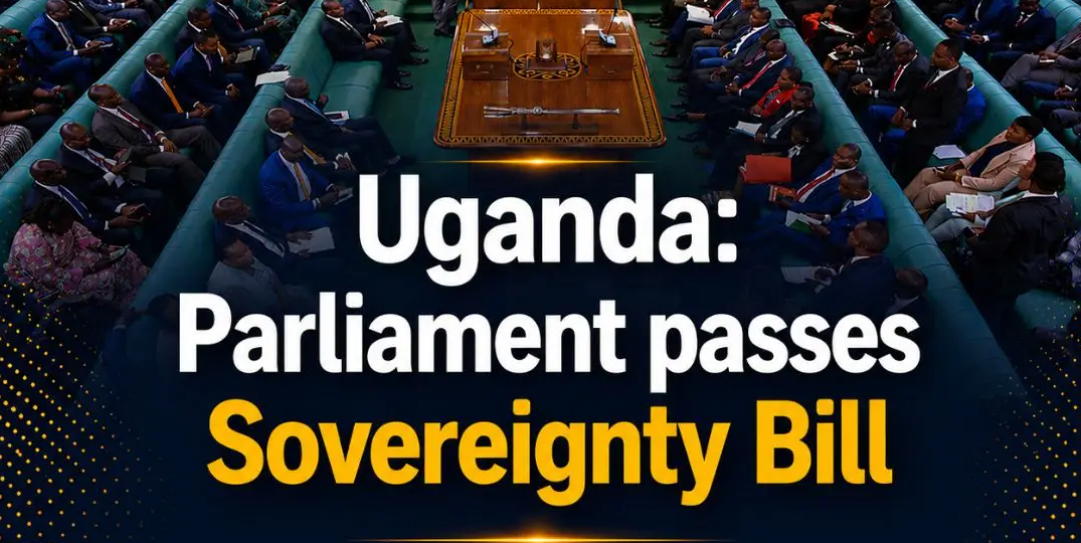
The ink on the amended Protection of Sovereignty Bill, 2026, is barely dry, but Uganda’s civil society already feels the chilling breeze.
Parliament has passed it. The President’s pen hovers. For organisations like ours, scrutinising barriers and enablers of an inclusive and equitable food systems transformation, such as land governance, climate change financing, agrochemical regulation failures, shrinking agriculture budgets, and broken extension systems, the Bill lands differently than it does for most. Actually, it is a dagger aimed at the heart of our work, as our work is now a potential crime.
The Act prohibits any activity that promotes the interests of a foreigner against the interests of Uganda. Worse still, speaking on climate or economic policy that a Minister deems “foreign” and not “adopted by Cabinet” now carries a 20-year prison sentence.
What changed between versions? Some relief but read the fine print.
The revised bill brought real improvements. The original swept up virtually anyone receiving foreign financing. The amendment narrowed this: the law now targets parties engaged specifically in political activities furthering foreign interests. Academic institutions, health facilities, faith-based organizations, and commercial entities received explicit carve-outs under clause 2(4)-(5). The word “intentionally” was inserted into several offence provisions as a crucial due-process safeguard. Premises inspections now require a court order. The blanket ministerial power to declare anyone a foreigner by statutory instrument was deleted.
Good. However, some of us are more worried than enjoying this sigh of relief. The definition of “political activities” (clause 1) includes influencing the formulation of government policy and influencing the public to oppose government policy. That is literally our mandate: presenting evidence, publishing alternatives, and mobilizing public attention through mass media.
Operating on foreign-sourced funding above 20,000 currency points (UGX 400M) without declaration triggers prosecution. Failing to register as an “agent of a foreigner” carries ten years imprisonment.
To its credit, Parliament softened the first version. They removed the blatant clause classifying Ugandan diaspora as “foreigners” and narrowed the definition of an “agent.” For that, we are grateful. However, the nuclear option punishing advocacy that questions a government project as disruptive remains.
Uganda’s 10-fold $500B growth strategy needs us.
The irony is tragic. The government’s Tenfold Growth Strategy dreams of a $500 billion economy by 2040, and agro-industrialization is the first among the ATM growth pathways. How do you reach that without our rigour?
Food systems transformation, safer inputs, reduced post-harvest losses, food safety, and functional markets demand credible independent oversight. Evidence globally shows that countries that suppress policy critique pay productivity penalties.
Who will audit the food safety chain, call out inefficiency in the delivery of government programmes, or demand better budgets for agricultural research?
Innovation and integrity of our agrifood system are built on the backs of a vocal civil society like us. Silencing us is a guaranteed way to stifle the food systems, crash export markets, and breed hunger and Malnutrition.
Constructive paths forward: there are precedents.
Kenya’s Public Benefit Organizations Act creates a tiered, transparent registration framework balancing accountability with operational freedom. Brazil’s Civil Society Framework (2014) formalised government-CSO partnership agreements. These demonstrate that regulation and partnership are not opposites.
So, what now? The President must choose: sign this bill and watch foreign aid through NGOs evaporate, or return it to Parliament with further amendments that guarantee safe harbour for lawful advocacy.
We are not the enemy. We are the alarm system for a nation that is trying to feed 50 million people by 2040. Switch us off, and you sleepwalk into a food and Malnutrition abyss.
We remain at the table constructively, professionally, and awake.