
Away from the shores of Lake Victoria, aquaculture is hailed as the blue revolution for Uganda’s fisheries sector. Yet, beneath the shimmering surface of this growth lies a silent crisis. The very practices designed to fatten fish are fattening the bills for farmers and loading plates with invisible threats.
As we pursue the human Right to Adequate Food, we must confront an uncomfortable truth: our fish husbandry and feeding practices are contaminating both the production system and consumers.
The Cost of “Cheap” Feed
The majority of Ugandan fish farmers rely on untested, homemade feeds a concoction of maize bran, fishmeal, and often whatever agricultural byproducts are on hand. The immediate benefit is low upfront cost. The long-term cost is catastrophic. According to a 2024 review in Aquaculture Nutrition on the East African fish feed sector, most farmers lack the tools and record-keeping even to calculate their Feed Conversion Ratio, let alone optimize it, which means poorly formulated feed quietly drains their margins without them ever knowing exactly how much they’re losing. Earlier FAO research on Uganda’s aquaculture inputs found much the same thing: farm-made feeds are so inconsistent that there’s no reliable data on their FCR at all, only anecdotal reports of stunted growth and wasted feed. In essence, farmers are spending more to grow less, perpetuating a cycle of poverty.
Bad Practices, Ugly Pathogens
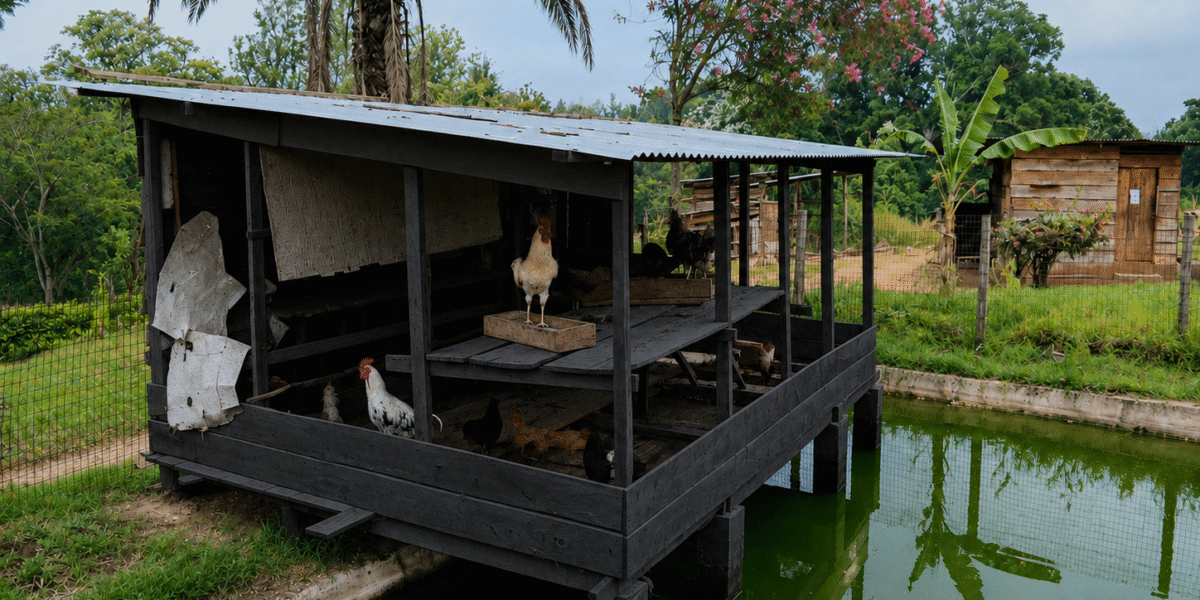
The real danger, however, is what we cannot see. Take the increasingly popular practice of stacking livestock above the water. Across Uganda’s Central Region, it is common to find commercial farmers erecting poultry or rabbit pens directly over fish ponds. The mesh floors allow a steady cascade of manure to plummet straight into the water, intended as a free, high-nitrogen fertilizer. However, this shortcut is a ticking time bomb. This direct dumping bypasses any natural composting cycle. Beyond the sheer organic load that triggers deadly ammonia spikes, the untreated feces carry a concentrated payload of pathogens.
Furthermore, antibiotics routinely added to poultry and rabbit feed, such as oxytetracycline, are excreted unchanged into the pond, fueling antimicrobial resistance (AMR) in aquatic bacteria, a silent pandemic we are only beginning to quantify.
Other Common Bad Practices Compound this Risk
Using raw manure directly (without pen integration): Even when not dropped from above, untreated livestock manure introduces a cocktail of enteric pathogens when shoveled directly into ponds.
Storing feed in humid conditions: This promotes mycotoxin-producing molds, specifically aflatoxins.
Feeding with “trash fish” and abattoir waste: Feeding fish “trash fish” and abattoir waste is not just a shortcut; it is an open invitation for zoonotic bacteria to move straight into the water column. These practices turn a pond from a farm into a petri dish. The usual suspects are Salmonella spp., Vibrio cholerae, and E. coli pathogens that do not care whether they came from a feed sack or a slaughterhouse floor. And this is not just a scary hypothetical. A 2020 study testing fish sold at Lake Victoria landing sites and peri-urban Kampala markets found that a striking 63% of samples came back positive for Salmonella, a clear sign that what is happening upstream, from poor on-farm hygiene to unsafe feed sourcing near livestock waste, is ending up on people’s plates (Muhame et al., 2020).
For consumers, this translates to a heightened risk of foodborne illness, undermining the nutritional benefits of fish consumption.
To break this cycle, we need governance, not guesswork. I recommend the following evidence-based actions:
Mandate “Feed Safety Audits”: The Uganda National Bureau of Standards (UNBS) should require all commercial feed manufacturers to test for aflatoxins and bacterial loads, with results printed on every bag.
Reform “Green Pond” Subsidies: Provide tax breaks or micro-grants for farmers who adopt biosecure practices such as using certified pellet feeds and installing aerators. Crucially, these subsidies must explicitly penalize the direct dropping of poultry/rabbit waste into ponds, instead incentivizing the composting of manure before application to break the pathogen cycle.
Deploy Rapid Testing Kits: Equip district veterinary officers with portable ELISA test kits to screen fish at the point of harvest for pathogen presence, ensuring unsafe stock is diverted to processing (heat treatment) rather than fresh markets.
Launch a “Farm-to-Fork” Digital Traceability System: Use mobile technology to log feed batches, pond treatments, and the presence of overhead livestock pens, allowing for rapid recall during disease outbreaks and providing buyers with transparency on farming methods.
Aquaculture is Uganda’s lifeline. But a lifeline contaminated by aflatoxins, E. coli, and antibiotic-resistant bacteria from overhead rabbit and poultry droppings is no lifeline at all. We must shift the paradigm from “production at any cost” to “production with integrity ” because the fish that goes around comes around on your plate. The right to adequate food demands nothing less.