
A reflection for 2026, the International Year of the Woman Farmer
By Agnes Kirabo Lwampemula
The harvest is in. Maize has been dried on tarpaulins, shelled by the children after school, and poured into one big heap in the store. The whole family worked for it: the mother who weeded twice, the daughters who carried water, the sons who helped at drying time. Yet from the moment the heap is formed, it has one steward, the household head, and people begin to speak of it as his.
A few days later, a woman I will call Nabirye walks down to the garden carrying a basket of banana peelings, bean husks and dry leaves, the kind of kitchen waste nobody looks at twice. Beneath the peelings sits a few amounts of grain, taken from the heap in amounts too small for anyone to notice. At the edge of the plantation a trader on a motorcycle is waiting. He weighs the grain with a tin cup, counts out some notes, and rides away. That evening there is pasted smoked fish on the plate for children who have not tasted fish for months, and a small tin of Vaseline in her bag that she bought for herself. Nabirye is not one person. She is a composite of thousands of women in family farming communities across Uganda and beyond, and her story is rarely written down. Iam sure many of you identify with this experience.
In moralist societies, this quiet act is called stealing. I would like us to call it something else: a “small and secret withdrawal of wages that were never paid”. And I would like us to look closely at the man on the motorcycle, because the way we have judged him says a great deal about how little we have understood the food system around him.
The Work that Disappears into a Heap
Women are central to agrifood systems. The Food and Agriculture Organization of the United Nations reports that women make up 42% of the agrifood workforce worldwide, and that in 2021 agrifood systems employed 40% of all working women, almost the same share as men. The United Nations General Assembly named 2026 the International Year of the Woman Farmer precisely because this contribution so often goes unrecognised.
Recognition is not what women receive in return. FAO estimates that women in agrifood systems earn 78 cents for every dollar earned by men, and that women farmers face a 24% productivity gap even when they manage farms of the same size. In Uganda, women account for 24% of adult landowners compared with 37% of men, and only 39% of women have rights over the land they cultivate (UN Women, 2025). The Uganda Bureau of Statistics found that about 7 million households, roughly 80% of all households in the country, farm or keep livestock, and that most of them grow mainly for their own meals, with 14% producing only for the table and a further 68% selling only what is left over. Data from the national panel survey shared by Witness Radio also show that plots managed by men are 60% larger and more likely to carry cash crops such as coffee and bananas, 25% against 14% on plots managed by women.
Put these figures next to the heap in the store. Women supply a large share of the labour, hold weaker rights to the land, and have the least say over what happens when the crop is gathered into one pile under one name. The household may be doing well on paper, while the woman who helped to grow the harvest has no cash that is truly her own. A few cups of grain, sold quietly, become the only wage she can touch.
I should be honest about the limits of evidence here. No national survey that I know of counts these small hidden sales, because no questionnaire asks who sells what, to whom, and who keeps the money. That absence in the data should not be mistaken for absence in real life. Anyone who has sat with village women long enough has heard the story, usually told softly and usually with a laugh that hides the worry beneath it.
The Sweet and the Sour
The middleman is sweet to Nabirye for good reasons. He comes to her, so she pays no transport. He accepts a tin or two, so she does not need a full sack. He pays on the spot, so there is no waiting, no form and no questions. For a woman who cannot be seen to sell, he is the only market that fits her situation.
The sour comes quietly behind the sweetness. Because she must sell in a hurry and in secret, she takes the first price offered and cannot compare buyers or bargain. She cannot ask for a fair scale, because asking draws attention. She cannot save or grow the little she earns, because it must be spent before it is noticed. And if the household head discovers the missing grain, the cost may be trust, peace in the home, or worse. The trap is not the trader. The trap is a system in which a woman who has laboured all season has no safe and open way to earn from her own work.
What the Middleman Carries that Nobody Counts?
Public conversation about middlemen is often unkind. They are described as parasites who grow rich while farmers stay poor. Some traders do cheat, and I do not defend unfair scales or exploitative prices. But the blanket accusation hides a larger story that researchers seldom bother to calculate.
Think about what it takes to move a few tins of grain from a hundred scattered gardens into a mill or a regional market. Someone must travel to remote villages, often on roads that become rivers in the rainy season. Someone must carry sacks, borrow money to buy before the buyer pays, rent a store, dry the grain again when it is damp, sort it, grade it, and absorb the losses when it spoils. A study of Uganda’s maize industry found that farmers lose on average about 30% of production after harvest (Economic Policy Research Centre). Field experiments in western Uganda reported that about 25% of the weight of the maize bags farmers sold was defective, and that 70% of bags were classed as reject maize (Abdul Latif Jameel Poverty Action Lab). The same work noted that commercial buyers pay about 8% more than local traders, who act as the link between farmers and end buyers. If that gap were pure profit, the farmers would simply refuse to sell this way. What they are really paying for is a service: collection, sorting, drying, storage, transport, credit and risk. These costs are real; they are borne by someone, and they are almost never written into the story we tell about middlemen.
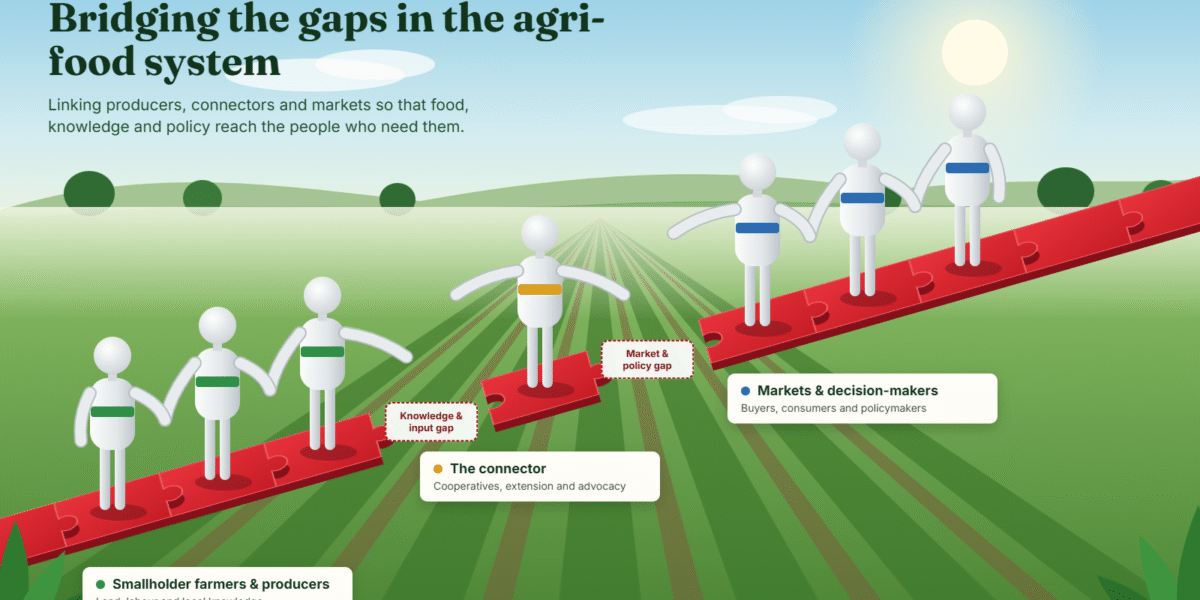
Seen this way, the middleman is a symptom as much as a cause. He thrives where production is fragmented into tiny plots, where villages have no shared drying floors or stores, where roads are poor, where market information travels by rumour, and where no organised buyer is willing to deal with a woman and her three tins of grain. He fills a gap that policy left open.
Why Phasing out the Middleman is the Wrong Target?
It is tempting to answer all of this with a simple slogan: remove the middlemen and farmers will earn more. But if we remove the person and leave the gap, someone else will fill it, often with less patience for small quantities. Worse, if the replacement is a cooperative or a bulk buying scheme that only accepts large lots registered under the household head, then the woman’s quiet channel closes, and nothing opens in its place. Programmes that celebrate collective marketing without asking who holds the membership card and who receives the payment can end up deepening the very control that pushes women into secrecy.
So the real question is not how to get rid of middlemen. It is how to make the functions they perform available in fair, open and affordable ways, and how to make sure women are able to use them in their own right.
Gaps and Opportunities for Action
Count what has not been counted. The new FAO gender domain within FAOSTAT is welcome, and national surveys can follow by asking who decides about sales and who keeps the income from each crop. Policy cannot respond to what it cannot see.
Recognise family labour. Agricultural plans at district and national levels, including those that follow the continental CAADP process, should name women family farmers as producers in their own right, with targets, budgets and indicators attached.
Build shared infrastructure close to the garden. Community drying floors, village stores, tarpaulins and honest weighing scales reduce the losses that eat into everyone’s income and make it possible to pay for aggregation services at a fair rate. Local governments can enforce standard weights and measures, so that a tin cup is no longer the only instrument of trade.
Make collective marketing work for women. Groups and cooperatives should register women as members, pay women directly where they have contributed, accept small lots, and have women in leadership. Mobile money and savings groups can help women hold and grow what they earn.
Strengthen land and household rights. Joint land documentation, consent provisions that work in practice, and community dialogues on shared decisions over produce give women legitimate standing at the point where the heap is formed, so that no one has to take from it in secret.
Share market information. Radio, mobile messages and village notice boards that publish current prices help women and men alike to know what their harvest is worth before the trader arrives.
Back to the Garden
Nabirye’s story is sweet and sour because it holds two truths together. A woman has found a way to feed her children and care for herself with the only resource within reach, and a food system has pushed her to do it in the shadows. The middleman has become both her rescuer and her risk, and he is a symbol of everything that is missing from the system around them: roads, stores, fair scales, information, shared decision-making and women’s legal standing on the land they work.
As we mark the International Year of the Woman Farmer, let us stop asking who to blame and start asking what the market is failing to provide. If we build the missing pieces and put women at the centre of the design, the quiet basket of peelings will no longer be needed, and the harvest that a whole family worked for can finally be shared by the whole family. I invite you to ask in your own community who sells the harvest, who decides, and who benefits. The answers will tell you where to begin.