
Why governing highly hazardous pesticides is a women’s rights and food systems issue
Commemorating World Food Day 2026 | By Agnes Kirabo Lwampemula, Executive Director, Food Rights Alliance
It is half past five in the morning in a vegetable-growing community in Uganda, and Tapenesi, as her peers call her, is already on her feet. She is not a woman I met last week. She is represents the women whose stories surface in farming communities across the country, and I suspect many readers will recognise her. She fetches water, feeds the children and walks to the tomato garden before the sun gets strong.
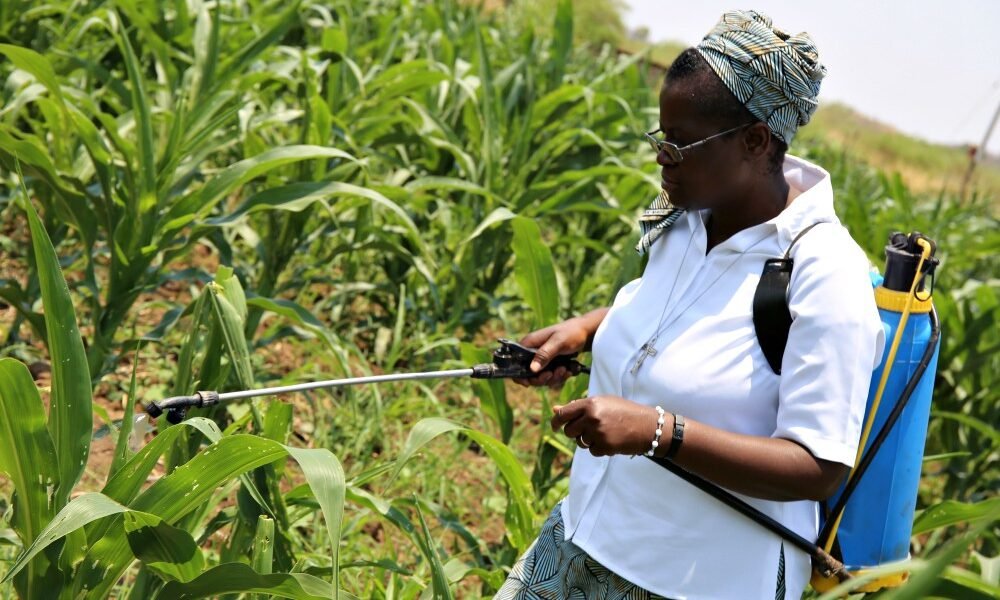
Her husband buys the pesticide at the trading centre and sprays the rows. Tapenesi follows behind. She weeds between plants that were sprayed the evening before, ties the vines, and by noon she is harvesting with her bare hands. In the evening, she rinses the sprayer at the edge of her compound, where the children play in the evening sun. She scrubs the work clothes, puts the half-used bottle on the kitchen shelf, and cooks the tomatoes that are too sour to sell.
Now picture a second woman, Grace, on a large estate. She is a casual worker hired by the season, the kind found on tea in western Uganda, flowers along the shores of Lake Victoria, palm oil in Kalangala, or sugarcane in Busoga and Bunyoro. She is handed a knapsack sprayer, or asked to mix and load. Her protective gear is shared, poorly fitting or missing, and nobody has told her which products in the store room are highly hazardous. To her, they are all the same. Grace is also a composite, and she does not describe every employer, but she describes enough of them to demand our attention.
Neither woman signed up to be a pesticide worker. Both are farmers, mothers and providers. Yet at almost every step of the working day, a chemical of the kind FAO and WHO classify as highly hazardous is close to their skin, their lungs and their kitchen. They are the frontline of Uganda’s food system, and they carry a risk that our governance has so far left them to manage alone.
Highly hazardous pesticides, or HHPs, are the small group of pesticides that present particularly high levels of acute or chronic hazard to health or the environment under FAO and WHO criteria, and they cause a disproportionate share of the harm (Food and Agriculture Organization of the United Nations [FAO] & World Health Organization [WHO], 2019).
Who is in the field
Women are 43% of the global agricultural labour force, and in Africa south of the Sahara more than 60% of employed women work in agriculture (Heinrich Böll Foundation, n.d.). Uganda sits at the heart of that pattern. The 2021 National Labour Force Survey shows that at least 65.1% of employed women worked in agriculture, often as independent workers with no hired employees (Kasirye et al., 2025).
Their exposure is not limited to the act of spraying. Research across Africa and beyond shows that women are exposed when they mix and load chemicals, when they weed and harvest on treated fields without protective equipment, when they wash spraying equipment and contaminated clothing, and when they store and dispose of containers at home (Asmare et al., 2022; Heinrich Böll Foundation, n.d.). Lower literacy and limited training deepen the risk. In studies in Bolivia, South Africa and Tanzania, women could not name the pesticides they were using or read the safety information on the label (Heinrich Böll Foundation, n.d.).
What the evidence says about Uganda
Start with the global scale. A recent study published in Frontiers in Public Health estimates that between 402 million and 433 million cases of unintentional acute pesticide poisoning occur every year among farmers and farm workers (Daily News, n.d.). These are modelled estimates, and much of the harm never reaches a hospital, a diagnosis or a national statistic (Devdiscourse, n.d.). Missing from the register of illness is not the same as missing from the lives ofvthe people.
Uganda’s own picture is sobering. Nearly 65% of the active ingredients on the national register are classified as highly hazardous under FAO and WHO criteria, and only 16 of the 643 registered products in 2022 contained any biopesticide component (Mayamba et al., 2025). In tomato production, one of the most chemical intensive enterprises on smallholder farms, 96% of farmers across eight districts reported using chemical sprays and 62% of them sprayed weekly (Ddamulira et al., 2021, as cited in Mayamba et al., 2025). A rapid assessment by the Association of Uganda Professional Women in Agriculture and Environment found that farmers in the central and eastern regions often apply pesticides and synthetic fertilisers on at least ten different crops in a single season (The Observer, n.d.).
National averages can look modest. The 2018 Annual Agricultural Survey found that about 21% of agricultural households used agrochemicals (Daily Monitor, n.d.). My reading of that figure is that exposure is concentrated rather than absent. It gathers in vegetables, horticulture and plantations, and it lands on the women who work those rows.
Knowledge is thin exactly where protection depends on it. In vegetable producing districts only 8% of farmers could interpret a pesticide label and 41% had no access to training on pesticide use, and an estimated 20,000 poisoning cases occur in Uganda each year (Mayamba et al., 2025).
The most telling evidence comes from a 2025 study of 584 farmers in Uganda’s tomato value chain. About 92% of them used chemical pesticides, so this is not a story of a few careless users. Women and men held almost identical views of how dangerous those chemicals are. Yet 17% of the women were the decision makers in tomato production, against 88% of the men, and 24% of the women had received advisory services, against 33% of the men (Mayamba et al., 2025). Key informants explained that men typically buy and apply the pesticides while women monitor the crop, harvest and handle the produce afterwards, which prolongs their contact with residues. Even where both spouses recognised the hazard, male control over household money kept higher risk products in the shopping basket (Mayamba et al., 2025).
Read that again. Awareness is not the missing ingredient. Power, access and protection are.
For a woman the stakes go beyond a bad week in the field. FAO and WHO warn that women are particularly susceptible to harm from highly hazardous pesticides (FAO & WHO, 2019). Pregnancy and breastfeeding mean that what reaches a woman’s body can reach her child, and what sits on the kitchen shelf reaches everyone 9n the plate.
Where governance is failing women?
The first gap is in the register. Civil society organisations have asked the Ministry of Agriculture to deregister at least 55 agrochemicals registered in 2023 that are banned in the European Union (Witness Radio, n.d.), and they have called for restrictions on substances such as glyphosate and chlorpyrifos (Jaramogi, n.d.). The Ministry’s position is that Uganda has a working framework in the Agricultural Chemicals (Control) Act of 2006 and the National Agrochemicals Register, that amendments against counterfeit and unapproved products are being prepared, and that a special committee is assessing highly hazardous pesticides for possible phase out (Publicist East Africa, n.d.). Both positions contain truth. A law on paper protects nobody until the register, the agrovet shop and the field reflect it, and civil society groups point out that implementation remains weak (Jaramogi, n.d.).
The second gap is the label. A warning in small print, in a language she did not study, on a sachet sold in a quantity the shop decided for her, is not protection. With only 8% of farmers able to interpret labels in the survey districts, information that cannot be read is information that does not exist (Mayamba et al., 2025).
The third gap is the advice. Advisory services reach fewer women than men, and in my experience safe use messages are built around the person holding the sprayer, who is often not the person with the longest daily exposure. The woman who weeds, harvests and washes the equipment is left outside the conversation.
The fourth gap is the workplace. Casual and seasonal arrangements on large farms can leave women outside the training, protective equipment and health follow up that formal employment would bring. Workplace safety rules exist, but a woman hired by the day is poorly placed to ask for gloves that fit or to refuse a task that endangers a pregnancy.
The fifth gap is data. Pesticide poisoning is estimated rather than counted, and what is not counted rarely competes for budgets. Without figures that show who is poisoned, where and how often, women’s exposure stays invisible to planners.
The sixth gap is coherence. The National Development Plan IV prioritises commercial agriculture, and in practice commercialisation often means more chemical inputs. Without a matching safeguard, the productivity agenda and the health agenda pull in different directions, with women standing in between.
Opportunities already within reach
The world has handed Uganda a yardstick. Target A7 of the Global Framework on Chemicals, adopted in 2023, calls for the phase out of highly hazardous pesticides in agriculture by 2035 where risks have not been adequately managed and safer, affordable alternatives are available (Daily News, n.d.). That is less than ten years from today. The Ministry’s agrochemicals committee gives the country an institutional home for the work, and a government that says it is open to phase out has already named the direction of travel.
Markets are pulling the same way. Civil society analysis warns that weak control of hazardous agrochemicals has already cost Uganda lucrative markets for its produce (Daily Monitor, n.d.), and the European Union remains a major destination for Ugandan exports (Witness Radio, n.d.). Cleaner production is becoming a commercial advantage.
Women are part of the solution and not only the people at risk. Rural women in the Global South have taken the lead in moving away from pesticides toward agroecology (Heinrich Böll Foundation, n.d.), and one agrodealer interviewed in the Ugandan tomato study observed that women are more receptive to low risk products than men (Mayamba et al., 2025). Evidence suggests that less hazardous products and agroecological practices can reduce poisoning without necessarily lowering productivity (Devdiscourse, n.d.). One caution belongs here. Natural does not always mean harmless, and some homemade preparations, such as tobacco extracts, carry real toxicity (Mayamba et al., 2025). Training must help women tell the difference.
This is where the World Food Day theme earns its meaning. Innovate today, nourish tomorrow. Innovation is not only a drone or an app. It is also a pictorial label in Luganda, Runyakitara, Acholi and Ateso, a poison information line a health worker can call, a women’s agrovet cooperative that stocks safer products, and a procurement rule that rewards the estate that protects its workers.
What must happen now?
The Ministry of Agriculture and the Agricultural Chemicals Board should publish a time bound plan to phase out highly hazardous pesticides, starting with products already banned in major export markets, and decide registration on hazard rather than convenience. Labels should carry local languages and clear pictures, and the sale of repackaged or unlabelled products should end.
The Ministry of Gender, Labour and Social Development and district labour offices should inspect plantations for protective equipment that fits women, training in a language workers understand, and the reassignment of pregnant and breastfeeding workers away from spraying.
The Ministry of Health and district health teams should record poisoning by sex and occupation, equip health workers to recognise and treat it, and publish the numbers.
Extension services and development partners should design advice for the whole household, put women’s groups at the centre of farmer field schools and radio programmes, and fund the supply of safer alternatives so that the safe choice is also the available and affordable one.
Plantation owners, exporters and buyers should treat women’s pesticide exposure as a matter of due diligence and not of public relations.
Consumers and the media can ask where the tomato came from and who was hurt in growing it. And women farmers and their organisations hold the strongest evidence of all, which is their own experience. Organise it, document it and claim a seat where inputs are registered, priced and promoted.
The national policy dialogue after World Food Day, planned for Kampala on 29 October 29, is one place to put these asks on the table.
Back at the stream
Tapenesi rinses the sprayer once more and carries the water home. The innovation she needs first is modest and powerful. A product she can trust, a label she can read, a voice in what goes into the sprayer, and a health system that recognises what is making her ill. If we govern for her, we govern for the food system she has been carrying all along.